News consumption in 2026 is defined by a profound reconfiguration of the media landscape, driven by a growing erosion of public trust. According to the Reuters Institute’s Digital News Report 2026, this shift is playing out through a massive migration toward social platforms and a surge in active news avoidance. For communications professionals, understanding these dynamics is essential to restoring brand credibility, optimizing audience engagement, and knowing how to manage information fatigue.
Key Takeaways
- News consumption in 2026 is marked by rising distrust and active avoidance of the news cycle.
- Social platforms have overtaken traditional media as the primary gateway to information.
- Information overload is pushing audiences to filter content in order to protect their attention.
- Transparency of intent and editorial quality are becoming strategic assets for rebuilding trust.
- Brands must prioritize content relevance and hierarchy over sheer volume.
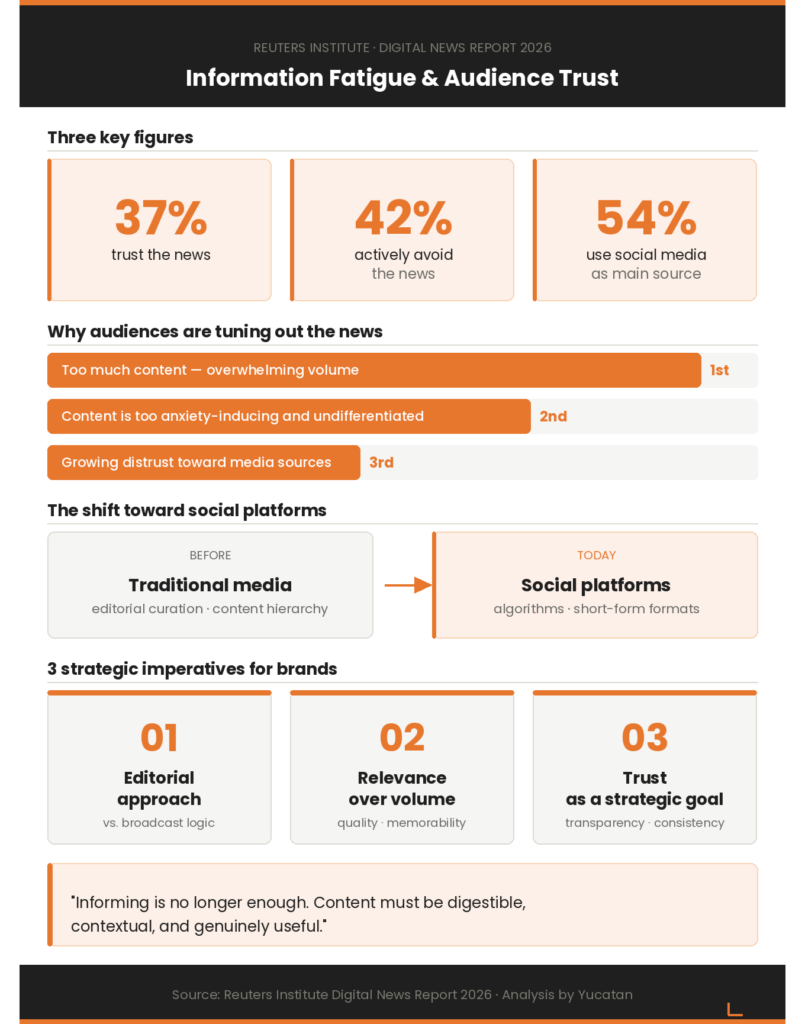
A few figures capture the scale of the phenomenon: only 37% of respondents say they trust the news, and 42% actively avoid it. Meanwhile, social networks and video platforms have become the leading point of access to information (54%), ahead of traditional media.
This is more than a crisis — it is a paradigm shift.
How Audience Information Fatigue Is Reshaping Expectations
News avoidance doesn’t reflect disengagement — it reflects saturation. Too much content, too anxiety-inducing, too undifferentiated.
The result: audiences filter, select, and increasingly disconnect.
In this environment, the value of content no longer rests solely on its subject matter, but on its ability to:
- deliver clarity,
- provide context,
- and fit into a managed, intentional use of attention.
Informing is no longer enough. Information must be digestible and genuinely relevant.
The Impact of Social Platforms on Information Distribution
The shift toward social networks marks a structural transformation: news is now consumed in algorithmic environments designed to capture attention, not to organize or prioritize information.
This has three direct implications:
- Short, visual, and first-person formats are becoming dominant.
- Hybrid profiles — experts, independent journalists, influencers — are gaining credibility.
- Algorithms play a central role in determining what information audiences actually see.
For brands, this means one thing: adapting a message is no longer enough. Content must be conceived natively for these environments.
Why Trust Has Become a Strategic Asset in Editorial Communications
In a climate of widespread distrust toward media, brand credibility is no longer a given — it must be built through transparency.
It rests on very concrete foundations:
- transparency of intent and sources,
- consistency over time,
- the ability to resist opportunistic communication patterns.
Brands have an opportunity here: by producing useful, educational, or explanatory content, they can build more durable relationships with their audiences — as long as they don’t overplay the role.
Why Editorial Quality Must Take Priority Over Volume
Faced with information overload, brands’ mass content production is showing its limits — and may actually reinforce audience avoidance. Understanding how to manage information fatigue means fundamentally reassessing content output.
The most effective strategies today are moving toward:
- reducing noise,
- sharper prioritization of brand messaging,
- higher editorial standards.
This represents a meaningful shift: performance is no longer purely a function of visibility, but of relevance and memorability.
Strategic Implications for Brands and Communications Professionals
Three major shifts are taking shape across communications strategies:
- Moving from a broadcast logic to a genuine editorial approach.
- Designing content for real audience behaviors, not historical templates.
- Making trust a primary strategic objective — not a secondary benefit.
In this new landscape, communications becomes less intrusive, more contextualized, and potentially far more useful.
These changes also open real opportunities: for brands capable of producing content that informs without overwhelming, that engages without manipulating, and that finds its place in a rapidly evolving media ecosystem.
Is your content strategy keeping up with shifting audience behaviors? Contact us