When an artificial intelligence answers a question about a brand, a sector, or a market, it no longer draws on a single authoritative source. It assembles its answer from communities, creators, experts, media, and institutions. Each of these sources is then weighted according to how the engine interprets its credibility.
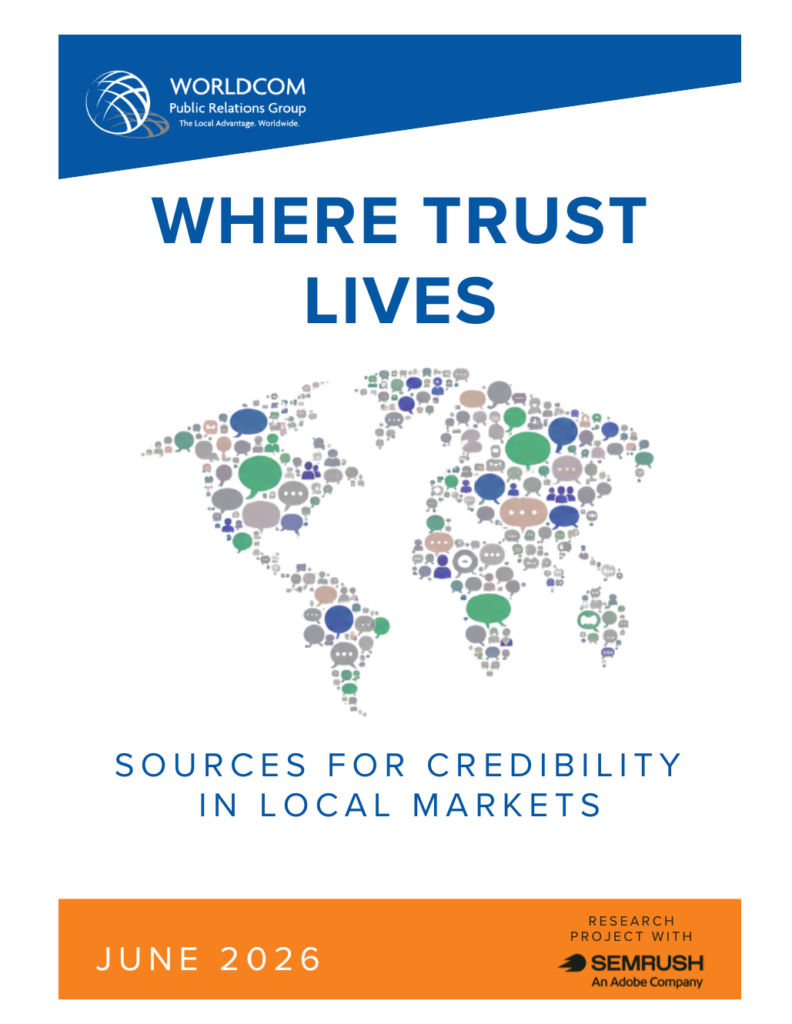
This is exactly what is at stake in “Where Trust Lives,” the study published in June 2026 by Worldcom PR Group in partnership with SEMrush. Over eight months, from October 2025 to May 2026, the analysis examined citations from ChatGPT Search, Gemini, Google AI Mode, and Perplexity worldwide, across eight markets. Its findings reframe, in very concrete terms, what it means to “be visible” today.
Why have social platforms become sources of evidence?
The most striking finding: six of the fifteen domains most cited by AI are social, video, community, or professional platforms. Reddit, YouTube, X, LinkedIn, Facebook, and Instagram are no longer marginal citations—they are primary signals.
These channels have long been viewed as simple distribution tools, meant to push a message outward. The study shows the opposite: their conversational nature also makes them data environments that AI reads continuously. What communities say, what creators demonstrate, the discussions and opinions of professionals—all of these are signals that become evidence cited in generated answers.
For marketing and communications teams already active in communities and local engagement, this is a direct validation. Authentic participation, expertise shared on LinkedIn, and video explanations on YouTube are not just reach tactics. They are credibility inputs into the AI answer layer.
Is there a universal hierarchy of sources?
No—and this is one of the study’s most actionable lessons. The global ranking offers a useful overview, but it conceals an essential reality: each engine has its own citation behavior.
In the era of classic SEO, mastering Google’s algorithm meant you could secure stable rankings elsewhere. That is no longer the case. A strategy built around the preferences of a single engine underserves all the others:
- ChatGPT Search combines community and reference: it links community credibility (Reddit, X) to more vetted sources (Wikipedia, NIH, arXiv).
- Gemini cites less often: roughly 62% of prompts versus more than 95% for the others. Its data should be interpreted with caution.
- Google AI Mode is dominated by video and platforms: YouTube, LinkedIn, Reddit, and social networks.
- Perplexity favors a professional, source-rich profile: YouTube, LinkedIn, X, NIH.
AI visibility is therefore not a technical matter. It is a strategic requirement: it has to be approached engine by engine, and market by market.
Why does local presence outweigh the global message?
For a global brand, the impact of Reddit, YouTube, X, and LinkedIn shows up in the worldwide table. But the real differentiation lies elsewhere: for market-specific prompts, local sources become priority citation signals.
The study’s data confirm this market by market. In Brazil, government domains and major media appear alongside global platforms. In Singapore, it is service providers and local authorities that stand out. In Germany, commerce and specialized sources coexist with the web’s giants.
Nothing can replace this local grounding. It is specific to a language, a category, a culture. It cannot be centralized or managed from a distance: it is built as close to the market as possible. This is precisely where a network of locally embedded specialists holds an advantage that is hard to replicate.
From distributing messages to distributing evidence
The shift in framing comes down to a single sentence. Traditional campaign planning asked: “What message are we publishing, and where?” Communications in the AI era pose a more demanding question: “What evidence will audiences—and, by extension, AI—find when they look to validate us?”
That evidence must be authentic, because AI often cites sources in the very places where audiences are already asking concrete questions. A vague brand claim carries less weight than a credible answer: an on-the-ground proof point, an identified expert, a reliable third-party article, or a community discussion that validates the message.
The study identifies six layers of evidence that AI draws on: community and discussion, video and demonstration, professional credibility, reference and research, editorial and business media, and local authorities and services. The strategy is not to chase every cited domain, but to build a distributed credibility system, tuned to the market, the category, and each engine’s behavior.
Do global brands need local approaches to be represented faithfully in each market?
In closing, the “Where Trust Lives” study delivers a few simple principles:
- Trust is becoming machine-visible through citations—but a citation is not trust. A share of a brand’s reputation now escapes it: AI composes that reputation from what is said about the brand. This is terrain that communications professionals must now monitor closely.
- Answer systems reward source ecosystems, not isolated claims. Credibility must be distributed, including geographically.
- Community, video, professional networks, media, institutions, and local authorities now belong to the same chain of evidence.
- Every engine behaves differently: strategy must be segmented, not applied uniformly.
“Where Trust Lives — Sources for Credibility in Local Markets.” A Worldcom PR Group x SEMrush study, June 2026.
Request a copy of the study – Click HERE
You have a project of GEO content strategy ? Contact us